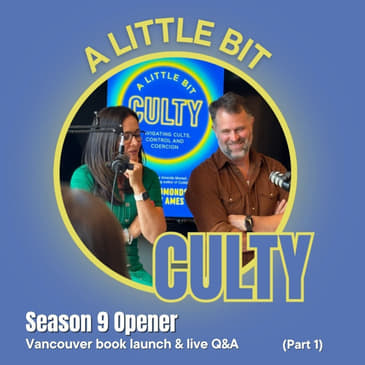
We’re kicking off Season 9 live from our very special book launch conversation from July 2026 in Vancouver about our book, A Little Bit Culty: Navigating Cults, Control and Coercion. We chatted about the messy, hilarious, full-circle journey behind the book, then get into how to support someone who may be caught in a high-control group without pushing them further into isolation. We unpack love bombing, indoctrination, behavior and thought control, loaded language, personality changes, and the all-important question: is what you signed up for actually what you’re getting? Stay tuned for Part 2 on Thursday.
Special thanks to:
Megan Williams at The Self-Publishing Agency for emceeing
Eric Lee at CoFunction Events & Workspaces for generously hosting us: cofunctioneventspaces.com
Jennifer-Lee Gunson for recording: podcastconsulting.ca
Trigger warning: This episode contains frank discussion of cultic control, coercion, indoctrination, emotional abuse, isolation, trauma, and leaving high-control groups.
Also…let it be known that:
The views and opinions expressed on A Little Bit Culty do not necessarily reflect the official policy or position of the podcast. Any content provided by our guests, bloggers, sponsors or authors are of their opinion and are not intended to malign any religion, group, club, organization, business, individual, anyone or anything. Nobody’s mad at you, just don’t be a culty fuckwad.
Buy the A Little Bit Culty paperback, ebook, or audiobook on Amazon or order a signed copy.
Check out our amazing sponsors
Join A Little Bit Culty on Patreon
Get poppin’ fresh ALBC Swag
Support the pod and smash this link
Check out our cult awareness and recovery resources
Watch Sarah's TED Talk and buy her memoir, Scarred
CREDITS:
Executive Producers: Sarah Edmondson & Anthony Ames
Production Partner: Citizens of Sound
Co-Creator: Jess Tardy
Audio production: Will Retherford
Production Coordinator: Lesli Dinsmore
Writer and administrator: Sandra Nomoto
Social media team: Eric Skwarzynski and Brooke Keane
Theme Song: “Cultivated” by Jon Bryant co-written with Nygel Asselin
SUPPORT OUR SPONSORS:
Go to https://OmahaSteaks.com and use promo code CULTY at checkout for $35 off. Minimum purchase may apply.
Find the fall pieces you’ll reach for most at Quince. Download the Quince app for app-exclusive offers, or go to Quince.com/culty. Get free shipping on your order and 365-day returns. Now available in Canada and the UK, too.
You’re going to love Hungryroot as much as I do. For a limited time get 40% off your first order PLUS get a free item in every box for life. Go to Hungryroot.com/culty and use code culty.
Transform your space with pieces that hold up to real life. Join Wayfair Rewards today and get 5% back on every purchase. Head to Wayfair.com or shop the Wayfair app for all things
home.
To get your new wireless plan for just 15 bucks a month, go to MINTMOBILE.com/culty.
The Everyday Earbuds Classics are the perfect companion for your fall reset. Go to BUYRAYCON.com/CULTY to get 20% off. Thanks to Raycon for sponsoring!
Join the millions of customers who trust HomeServe. For 50% less your first year, go to HomeServe.com/culty.
That scratched up pair has done its job. Upgrade today with Zenni! Go to ZENNI.COM/PODCAST and use code PODCAST15 for 15% off your first order, plus free shipping on all US orders over $65. The styles sell out, so don't sit on it.
See Privacy Policy at https://art19.com/privacy and California Privacy Notice at https://art19.com/privacy#do-not-sell-my-info.
[00:00:00] Football season is here, which means our weeknights are basically chaos. Practice, game, someone always needs to eat at the oddest hour, and somehow, we never get organized enough to meal plan on the weekend. Classic move in our household. Having quality protein already on hand has been a lifesaver, and that's exactly why we love Omaha Steaks. Grab the filet, throw it on the grill, three minutes each side, butter in my mouth. They've got ribeyes for those special occasion nights, juicy burgers for a quick cookout, grilling chicken, seafood, gourmet Franks, whatever.
[00:00:30] Whatever you need, they've got it. Plus, sides and desserts. So dinner's basically done for you. Everything's meticulously aged and vacuum sealed individually, shipped nationwide, arrives frozen and ready for grilling, searing or roasting with almost no effort. No last-minute store runs mid-baseball season panic, and honestly, store-bought just can't touch the quality Omaha spent generations perfecting. Right now, for $79.99, you get their Burger Perfection Flight. 20 Premium Steak Burgers.
[00:01:00] 4 Pure Ground Filet Mignore. 4 New York Strip. 4 Rib Eye. 4 Brisket. 4 Sirloin. Each one bringing its own flavor to the grill. Boom. Basically, dinner's handled even when your schedule absolutely isn't. Try the Burger Perfection Flight at OmahaSteaks.com today.
[00:01:17] That's 20 Premium Steak Burgers for just $79.99 plus get $35 off with promo code KULTI. That's OmahaSteaks.com promo code KULTI for $35 off at checkout. Terms apply. See site for details. I'm calling Shannon Maldonado and I'm the founder of Yaoi, a gift shopper, which is specialized on art and hand-fitted objects.
[00:01:41] My choice was on Shopify, because Shopify compared to the other platforms, which I tested, was the most friendly user-friendly. I thought especially about the future. All tools, which are important for the sales price, for example, for Lager-Beständen, you can find directly in the dashboard. Starte jetzt deinen kostenlosentest auf Shopify.com. This podcast is for informational purposes only and should not be considered legal, medical, or mental health advice.
[00:02:06] The views and opinions expressed do not necessarily reflect the official policy or position of the podcast and are not intended to malign any religion, group, club, organization, business, individual, anyone, or anything. I'm Sarah Edmondson. And I'm Nippy Ames. And this is A Little Bit Culty, the podcast where we unpack cults, control, and coercion.
[00:02:35] We woke up from a cult. The whole wild ride ended up in The Vow on HBO and in my memoir, Scarred. Now, after eight seasons of hearing every kind of culty story imaginable, we've bottled up everything we've learned into a book, also called A Little Bit KULTI. It's available now in all formats on Amazon, Audible, and where fine books are sold. Or get a signed, personalized copy on our website. Better yet, ask your local bookstore or library to order it and encourage them to get on that cult awareness bandwagon.
[00:03:01] On the show, we break down the shame and secrets that make these experiences so destructive with honest conversations about how everyday groups can slide into the cultiverse. Each week, we bring in experts, survivors, and whistleblowers to talk red flags, resilience, and recovery. And yes, we still make time to laugh. Sometimes you have to, or you'll cry. Want early ad-free episodes, live Q&As, and exclusive extras? Join us on Patreon at patreon.com slash a littlebitkulty. Welcome to Season 9 of A Little Bit KULTI.
[00:03:31] Taking down the depths of the ocean. Welcome back to Season 9 of A Little Bit KULTI. Can you believe nine seasons here? I can't, Nippy. And I can't imagine doing it with anybody else. My sweet and charming husband. Well, you can imagine it. It probably wouldn't be as good, but carry on.
[00:03:59] Super excited to share something that we've never done before. We got to see a whole bunch of you in person for our Vancouver launch, an event for family and friends and fans. We gathered at co-function events and workspace for a book launch. And honestly, it was a great treat. We got to meet listeners face-to-face, which I always love because it's direct feedback. Answer your questions. Talk about all things KULTI and recovery. And perhaps most importantly, sign a lot of books. There's something kind of surreal about spending so many years talking to a microphone
[00:04:28] and then getting to look out into a room full of actual humans who've been listening along with us all this time. Yeah, you never really get to understand what kind of impression you have until it's live. Face-to-face. Yeah. So for this episode, we're sharing the Q&A from that night, which is, in my opinion, valuable and more raw and authentic. We had great questions, serious, funny ones, and always productive. So to everybody who came out, thank you. We were genuinely thrilled to meet you, hear your stories, and spend a little time together, IRL.
[00:04:57] Consider this episode our way of bringing a little bit of that special Vancouver night back to you, wherever you're listening from. And special thanks to Eric and Bubby for organizing the event. Bubby, we see ya. That's Bubby. That's Sarah's mom, just so you didn't know. Ellen, thank you for providing the food and booze. The Bubbinator, we like to call her. And for making this such a special night. And just to echo what Nippy said, Eric Lee from CoFunction saved the day.
[00:05:22] As many of you know, this event had to be rescheduled space-wise, and we'll tell that story on a separate podcast. Yes, and Jim, too, of course. Sarah's dad. Who is our spontaneous bartender. And Sandra for helping to shuffle the whole thing over to the new space. Tons of thanks. So many people. You know who you are. Thanks for making it happen. Thanks to our listeners who came out and supported this event. Enjoy. Looking forward to coming to your town next. For now, here we are from Vancouver.
[00:06:03] Well, it was funny. I was talking to Sarah and Nip on the way in today. And I don't know how it came up, but we just recognized that, like, wow, it's like this feels like really full circle for us. Because I remember being at a brunch with Sarah, and we didn't know each other really. And she's like, yeah, I, like, my husband and I are thinking about starting a podcast, and I'm not really sure yet. But I think we're going to call it a little bit culty.
[00:06:31] And I remember my initial thought was like, ugh. You didn't tell me that. Same here. No, I kept, oh, I hadn't met you yet. And I kept that feeling to myself because we didn't know each other very well. But I was like, that's, that feels so, like, and I don't know how long ago that was now. But at the time, I felt like that feels so abrasive and abrupt and in your face. And only to know them now, you realize that is the furthest thing from what their podcast has become.
[00:06:57] And in fact, their podcast and everything that they do in their platform is the furthest thing from being abrasive and in your face. And in fact, it's being inclusive, and it's being sharp and thoughtful and poignant and bringing out conversations that no one was otherwise going to have. So sorry for quietly judging you about the name of your podcast. You guys have done your thing. Things went so well for you with your name.
[00:07:26] And just as a brief introduction, so my name is Megan. And when we entered, when Sarah and I were introduced, I hadn't really started a publishing company that was worth noting at that point. We were both in our infancies of trying something out. And it was like a need in the market, both in the call space. My need in the market was in publishing.
[00:07:50] And it wasn't until a little bit post-COVID that I messaged Sarah and I, we just ended up chatting. And the conversation evolved into she's like, you know what? Like, Nip and I have been talking about something that's like a little bit past my original book. Something that brings the bigger conversation of cults into the light. But not necessarily in the podcast world, but how do we publish this? How do we get these conversations in print so they last longer and they can be digestible in different ways?
[00:08:20] And it just so happened that, well, I have a business for that. And I have a business that will not censor what you have to say. And, you know, a couple years later, now we're dealing with a little bit culty, the best-selling book that you're all here to celebrate today.
[00:08:37] And I feel really happy that we are now in a space that is friends and family and is with fans of yours who are having conversations that we want to be having that is not doing a dance. And it doesn't necessarily even have to be a publishing conversation today. Today we get to have a conversation about some of the things that are really important, but pull some behind-the-scenes stuff from what everything that you went through in the publishing process.
[00:09:06] Is Sarah's mom here? You! Hi! So, well, I've heard lots about you and I'm very happy to meet you. But what I understand is who here, just to get a temperature check on the room, who here has known Sarah and Nip from NXIVM Life or knew them before? I mean, I hope you knew her before. Megan, I have to tell you, there's people here that have known me, like, since birth, like, family members. There's people here who helped us birth our children.
[00:09:35] There are people here that I've known since my acting life before NXIVM who were with me during that weird time when I was, like, a zealot, crazy person trying to recruit everybody. She can tell us some stories later. And there's people who've only listened to us since the pet, like, known us in our public space. And everything in between. There's a huge, wide range of friends and family, and it's amazing. It's a really special night, actually. Yeah. Looking out. It's kind of like our wedding again. We're going to renew our vows.
[00:10:03] And something that we had talked about earlier that felt really special is, and just as a show of hands, who here has read the book already? Great. Oh, you guys are in for such a treat. Great. So one of the things that struck me, because to know Sarah Nips socially or to know them professionally, is to know how their careers have evolved and to know how they show up for other people, how they show up for themselves, and how they show up in their advocacy.
[00:10:30] But what comes out in the book, and what I'm excited for all of you to read, is there's an extreme vulnerability that happens in this book, and an admission of things that they missed in their lives, the things that they didn't know, the things that they wished were going to be true and didn't become true.
[00:10:48] And I think today's conversation, because we're all friends here in one degree or another, I would love to hear you talk about, for anybody here who is in a relationship with somebody who has a child in a relationship, who might be part of an organization, what do you now, with all of the information you've gathered for your book and in your own life, what kind of advice could you share with a room, with people who are wondering, how do I broach this conversation?
[00:11:17] If my daughter is exhibiting signs of being part of something I didn't expect for her, or my friend is in a relationship that I don't really know how to say that there's something off about this, or they're in a workplace, or they have started selling a lipstick that doesn't quite feel like just a lipstick. What would you say to your room of friends about how could you broach that without isolating them? Okay. That is first. Thank you, Megan. Thanks so much for being here.
[00:11:46] This is very full circle. You know, this is something that we've learned the hard way, because as we woke up and tried to tell other people what we were involved with and that it wasn't good, we actually were very abrasive. And we scared a lot of people away by saying, oh my God, this is a cult. This is sex trafficking. This is crazy. And they were like, you're crazy because you're emotional and reactive, which in NXIVM land meant that we weren't, you know, to be trusted in that way.
[00:12:10] But I think we still learn this lesson daily as we can confront people who have different belief systems than ours. But also just, you know, when people do things you don't agree with and it doesn't matter about their belief system, the way they live their lives. But the advice is in the book. And there's actually a chapter that we wrote specifically. I think it's called How to Help Your Loved One. But what we've learned from the experts is that if you tell them they are in a cult, if you tell them they are wrong and you confront them head on, it never goes well.
[00:12:37] And the best thing is to listen with empathy and to ask questions about what they believe. What does this look like? What are your hopes and dreams in this scenario? That's a very specific thing. But in a situation where you have somebody involved in something you don't think is good, asking questions and being curious and listening empathetically is kind of the only way. If you tell them you are wrong, you've been indoctrinated, you are in a cult, that they're not going to hear you. Anything, Dad? Not much. It's funny.
[00:13:07] The distinction I would make is sometimes when someone's in a behavior, you can go like, that's weird or whatever. And you don't really think it's going to put them off, per se. Like, I told my brother, he's like, that's something like a cult. I go, that's not a cult. And I didn't take it in offense or anything like that. I didn't believe I was in a cult. But as I got more of that sounds like a cult, I got more defensive and dug in more. So I've been on both sides of it, you know, where it can be a benign accusation.
[00:13:31] I do think the more emotional and someone seems to identify with their belief system, there's no talking to them directly. You have to work somewhat strategically. And that's be their friend, ask them questions, all the things Sarah just said. Maybe drop off our book on our doorstep anonymously. We can sign it, too. Now, your brother's a perfect example of that. So did you, as you said, the more you heard it, the more you became defensive of it.
[00:13:57] So for somebody who is observing it, do you say, like, would you ever suggest, why are you being so defensive about that? Do you pursue that? Or do you just stay a loyal observer of what's happening and wait for them to come around full circle? Or and what I'm trying to get at for our friends is whether it's like an extreme stakes cult that somebody might be in or just in a scenario that you're like, this is seeming icky and I'm worried we're losing you here.
[00:14:24] Is there a specific type of question that you can ask them that you have experienced or you've heard people say that was the one that cut through the noise? One I hear a lot and everybody wakes up in different moments. Like when I say wake up, people realizing, oh, I've been indoctrinated. I was in a cult. Whatever that looks like for them. Usually comes from either an experience of their own awareness that what they signed up for is not what it was. And they have either they recognize that the leader lied to them. And it could be some small little thing.
[00:14:53] One distinction is case by case. It's case by case. Yeah. It depends how far people are in. It depends on how dedicated they're in, you know, like how entrenched. But one thing that people have been asked is like, is this what you signed up for? Like if you'd known at the beginning that you would be, you know, branded with the leader's initials, for example, would you have said yes? Obviously not. So I think that's something that you can ask people.
[00:15:17] Like, did you know that you were going to have to stop working and give all your time and money to the ex-organization, church, synagogue, yoga studio, whatever it is? You know, like, did you know that that's what was going to happen? And how do you feel about that? The other thing people have suggested is to do things with them that are things they don't get to do in the cult. Like, oh, we're going to go on a bike trip. Like, would you like to join us? You're not even talking about the thing. You're just giving them a little taste of their former life or pre-cult identity if they weren't born into it.
[00:15:45] Also, you have to understand what you're looking at. So if it's a person that's invested a lot into the persona and the belief system. Now, I heard Mick Jagger in an interview recently talking about this Rolling Stone interview going on, going around where he was just interviewed. And he said the problem with like the rock star image and all that is people put so much time and energy investing into that image, they become a character of themselves. And I thought, oh, my God, that's exactly what people happens with their ideologies. They identify themselves with their belief system.
[00:16:13] But depending on the person's level of self-esteem, if you go at it with a wrecking ball, they're just going to clam up and they're going to cling to that belief system. If they have kind of a little bit of self-awareness, you can drop a question that I think is at the wavelength of their self-awareness. That's going to require a certain amount of self-awareness on yourself and what you're sensitive to. And that's where it becomes a little bit of nuance. And it could be if it's your brother. My brother was like, dude, you're in a cult, but it's not all crazy. You know, and I could have that conversation with him. Where my self-image got challenged is when my brother called me up.
[00:16:42] He's like, no, I'm going to cuss here. It's in our book. Why the fuck am I getting a phone call asking someone so said that you wanted to join their cult? That's when I reconciled my self-image and how I was coming off to people. So I was like, oh my God, I think I'm coming off to people in a culty kind of way. So I dialed back the behavior, but also was still comfortably stupid that I was behind something noble. So it broke me a little bit and I had that sensitivity to it, but I still didn't believe I was doing something bad.
[00:17:09] And I identified with something that was good until all that came crashing down. So that was my kind of journey. And I think everyone has an experience. I'll give you a benign example. Michigan and Ohio State. You know, people feel very passionate about being a Michigan fan and Ohio State fan. And they identify with that and people fight over it in parking lots and, you know, in America. So again, I think you have to understand the psychology of what you're trying to address in a lot of ways. And most people don't.
[00:17:38] They react and see a loved one doing something that they're scared about. And they're not really coming from a place of like, I'm scared for my brother. I'm scared for my sister or whoever. So that's important. Great point. I want to add, I did say this at Banyan. So Troy and Kevin, these are repeat answers for you. But one thing that I will say is it's so important to be the person that they can reach out to you when they do wake up.
[00:18:02] And I will say that, again, mom and dad, both of you were totally, you know, the first, at least the first five that I was calling saying, yeah, I'm not doing that. And I'm not doing that anymore. I didn't have the full awareness yet. But to know that you weren't going to be judgmental or say, I told you so was really key. And I think that a lot of people don't have that because the more entrenched they get in and they feel that the people around them have been saying you're in a cult and what you're doing is bad.
[00:18:30] Those bridges are cut and burnt. So keep the bridge so that you can, they can cross it. Quick shameless plug for our book because there's a very exciting update. The audio book is officially out and it's narrated by us. So you can now read the book however you like. Hardcover, ebook or listen to us tell you the whole damn story ourselves. And if you've been listening to the podcast thinking, I know this story, what else is there to learn?
[00:18:59] We think you might be surprised because the book does something different. It pulls everything we've learned together into one place, not just what happened, but the patterns underneath it, the red flags we missed and what we understand now and what we hope you can take from our experiences and actually use it in your own life. And if you're more of a just give me the goods person, we've got you there too. There are simple takeaways and checklists throughout so you can skim, highlight, dog ear or come back to the parts that matter most.
[00:19:28] It's the story, yes, but it's also the, okay, what do we do with everything we've learned book and how do we use this information to protect us in the future? And now you can hear it in our actual voices, which feels like the perfect way to experience it. A Little Bit Culty Navigating, Cults Control and Coercion is available now in hardcover, ebook and audiobook wherever you get your books. And if you've already picked it up, first of all, thank you. Second, if you enjoyed it, please take a minute to leave us a review. Reviews make a huge difference in helping new readers find the book.
[00:19:58] And we do read them, all of them. Then pass that hard copy along, give it to a friend, leave it on someone's nightstand. Maybe give it to someone who might be in a cult, you never know. And save the audiobook for your next long drive. Gardening marathon, dog walk, closet purge or whatever activity makes you think, you know what could really improve this? A few hours of cult education. However you read it or listen or pass it along, we are so grateful you're part of this conversation. Enjoy!
[00:20:44] Thank you for listening. Now, let's dive back into the cultiverse. And in many cases, it's a nice sentiment, but did you feel like anybody had said it too many times? You're in a cult. Why are you asking me these questions? Did you feel that somebody pushed too hard? And then therefore the bridge has been... I wish people had pushed harder. Oh, interesting. In her respect.
[00:21:10] I mean, we are here where we are now and everything's fine, but nobody really confronted me head on. What did happen was a lot of people made jokes. Like my agent would say, are you in Albany again? Like, don't shave your head. And I'll be like, oh, I'm going to drink the Kool-Aid. Like, it was that kind of thing. And I knew why we looked culty. I knew why we looked weird. The sashes, you know, the calling Keith Vanguard. I knew that was all weird. But I also thought like, but they don't get why we do it. And if they understood why we do it, then they'd like it too.
[00:21:38] And I also had a lot of experiences of that where people were resistant, thought it was weird. I had one friend that was like resistant for 10 years and she finally came and she was like, oh my God, this is amazing. And I'm so sorry that I said it was a cult. I'm like, yeah, I know. It's okay. I get why it was. And then like two months later, no, it was like months later, I was like, you were right. It's a cult. We are out of here. And that was really hard too. But like, you know, this is where it goes back to the black and white thinking that we talked about that happened on Tuesday.
[00:22:06] Part of the whole sort of that whole discussion is that like, even though, yes, I was happy to be out and I was aware that it was a cult. I was also was black and white think I'm diverting. I know this is not what you asked, but I just wanted to say this. Well, I had it on my mind is that the black and white thinking was even like, OK, I'm out of the cult. That's bad. And there was actually so much good mixed in with the bat, which was also really hard for people to reconcile when they're waking up because this does go back to your question.
[00:22:33] And it's hard to leave because there's often community and family and support and positive things that make it like very fuzzy. The waters become very muddy and that's why it's hard to leave. And that was my long winded tangent. Did I answer the question? Absolutely. My answer is shorter. My parents thought I was in a cult, told me. And it's pretty much direct. Yeah. My dad's like, why are you following that douchebag? Yeah. And my mom was like, are you going up to Albany to do the cult again? I'm like, yeah, mom.
[00:23:02] And didn't work, by the way. So when we think of our like and because you guys have spoken to so many people who've had culty like behavior, like experiences, cultish like behaviors. What is something that's, and Sarah, you mentioned like the sense of community. And I think that's where even as somebody, a family member who might be watching yourselves like involved in a group, you're like, I don't know.
[00:23:32] There's something really good here. Like I do think I understand it. But there's this other layer. With everyone you've spoken to, how would you be able to, and I know you talk a little bit about this in book. How do you talk about or how do you, how would you guys articulate what that something is? Like they can't put their finger on it. But is that consistent across the board with everyone you've talked about?
[00:23:55] Where you're like, I see all the good things about this organization that they're part of, whether it's SoulCycle or Arbonne or, you know, Landmark. Like things that are very like in common vernacular, whether it's religious or otherwise. When you're listening to the people you've interviewed, is there a common thing that their family members or somebody is saying that they're like, it was just something. It just was a little bit odd. There's a personality change.
[00:24:19] I think people get, there's a real shift, which is unfortunate because with us, our personality change, I think was, at least for me, I didn't know you when you started. But like there was a lot of positive stuff too. You know, I was more motivated. I was more organized. I was actually, yesterday at our Indigo event, a casting director came who's no longer casting. And she said, I could say this publicly on the podcast. So thank you, Sue Brose, for being an incredible casting director.
[00:24:44] And she was saying that she saw my acting change, how I went from being kind of nervous and anxious in the room to being solid and like going in to do the work and not really giving a shit, which is really what you have to do to be a working actor. You can't care what people think. And she saw that change. And I think that there was so much positive stuff right at the beginning that, and I'm saying this because like if someone were to say to me at that time, you're in a cult, I'd be like, look at my life. It's so much better. How could you say I'm in a cult?
[00:25:13] And the problem is that pinpointing what's bad doesn't come then. The bad came later, at least for us. You know, the bad was a slow drip. It was a very slow turn up of control, which I think is the other thing, is that people become more and more controlled. They start living their life in a different way on other people's terms. They start using loaded language. I think that's another thing. Speaking of the language of this week, oh my God, the names we were called.
[00:25:38] Those terms that cults use to label us versus them, the good, the bad, the black, the white, whatever it is. Those terms become the coded language, almost like a secret club of the people. And so that's a thing, a real sign, I think, for indoctrination. I'll walk you through ours and do the pattern recognition thing. My brother and I were 15 months apart. And he was obviously one of the first people I thought of when we were doing this. Initially... Like to recruit? Yeah. Okay.
[00:26:06] Initially, when you do something like this, you sign up for the good thing. And then oftentimes, in our case, just talking about what's going on with you emotionally and was just something that didn't happen in my household, just quantifying it can change it. You put language to it. You start to evolve it. You start to become aware of it. You start to see it imbuing your behavior. Become more aware. It's going to change it. It's Heisenberg's principle. Just the fact that you're watching it and you can see it will change it. So I had some pretty cataclysmic changes right away.
[00:26:36] And I wanted my brother to do it. So my behavior changed and I became somewhat righteous about what I was doing. Right? And then I would have conversations with my father, who was vital in programming me. And I would start challenging some of his indoctrinations. So that was a little chasm. At first, I decided I wasn't going to let this curriculum and this cult get in the way of being my family. So I didn't really bring it up where it was. And I respected when I felt like there was pushback. All that said, my brother was like, hey, listen, I love the stuff that you're saying. It's great.
[00:27:06] But who's this guy? Like, why are you acting like he could sniff inauthenticity? And so I started to recognize I'm starting to put on a persona or I'm investing into a persona, Mick Jagger, Rockstar. And I'm somewhat of a character of my former self, but still me, but still trying to perform it. This is working. That makes sense. Yeah. I was somewhat a slave to a persona that I created for myself and wrestled with it. Right.
[00:27:32] Because inside the organization, I resisted a lot of stuff because I felt kind of myself. I go, that's not me. And I wouldn't follow certain rules and I wouldn't do certain things. I didn't wasn't as obedient within the organization. And I wasn't really conscious as to that's the reason why. And then you got labeled defiant. Yeah. Like we all. But I didn't care. That was the whole fucking thing. And they're like, see? And I'm like, so that was kind of my attitude around it. Because we get access to you a little bit in the MTV unplugged space here.
[00:28:02] I would like, before we open the room for questions, something that I'm personally curious about is because you have so many people approaching you to be on your podcast. And you have so many people. I'd love to talk to you about my cult experience because all of a sudden you've opened yourself up and all of a sudden now everyone's like, can we please talk? Of all the people that either have approached you or you've decided to vet to be on the podcast, have you noticed there?
[00:28:28] Is there anyone that has come into your space that you're like, I think you still might be in a cult? Yeah. Oh, yeah. The fact we've interviewed people. Absolutely. We actually did one. We had to pull off like we did it and then we had to take it offline because it was so problematic. Yeah. Problematic for the speaker or problematic? They were trying to get ahead of the narrative. By saying they were out, but they were actually perpetrators if we're talking about the same person.
[00:28:55] But there's been multiple situations where two things. One, the person shouldn't be talking about it. They're still in trauma. And so we kind of ask the questions. You can, I mean. We do a pre-interviews when we need to. Yeah. When you've spoken to so many people, had so many questions asked to you and you ask questions, people aren't that mysterious. So we are kind of algorithms in a lot of ways.
[00:29:19] And so you can kind of get a sense of where they are in their journey, how authentic they are and how prepared they are to handle questions that are really going to expose you. Like and the best stories are the ones where you're vulnerable, authentic and you lay it out there. And that that's hard. I got to ask in your pre-interview, do you have a question that you'll ask that often is the tell? You know what? I should. We don't have a we don't have a pre-interview set questions. It's more of like a check in.
[00:29:47] We don't pre-interview a lot of people, especially if they've done other interviews. And Sandra, who's here, helps to check this in. She does a lot of vetting for us because we can't do it for everybody. But if you've done if you've done other interviews, we can watch that and see like, OK, you're OK. You're not in trauma. You're all right. But we also like to talk to people who are fresh and like they've never we've done a lot of whistleblowing. People have whistleblowed on whistleblowed on blown. Lose the whistle on people who've never been exposed before.
[00:30:14] So those people are like they're in it like they're in it to win it. And they want to do it on the podcast. Like that's a really risky thing for us because we don't even know for sure much about this person, but we're just trusting our gut and we've made mistakes. And I think the biggest thing is that with the one case they'd left something turned out they'd left a bad work experience was calling it a cult wasn't a cult. It was just like they had a bad experience. Want in on the good stuff?
[00:30:43] Subscribe to our Patreon at patreon.com slash a little bit culty for bonus episodes, early access, ad free listening. And the warm feeling of knowing you're supporting independent podcasting. Truly could not do this without the patrons. No ropes required. And that was a word from our sponsors. Let's get back to the show.
[00:31:10] Just no curious when you guys like finish a podcast and you go for a walk. I'm just so curious about like the things that you got to talk about. But we got to talk about that interview. If it's trauma, we go for a walk and just shake it off. Which unfortunately, half of ours. Yeah. So we're sure we trauma. I'll just add a little bit. The journalist ones tend to have more of an intellectual like, hey, that was an interesting. I learned something.
[00:31:33] Not that I don't from the trauma ones, but like people that go balls deep into like one story can come out with wisdom that I didn't have. And I always appreciate that. How about the therapy ones? Like Dr. Romany or Ingrid? Well, wouldn't you say those? Yeah. Okay. Those ones I always feel like I can't believe how lucky we are that we got to spend an hour or two hours with a world renowned therapist talking about our... They're happy to be on our podcast. Happy to be on our podcast. We're like faking or like, oh, yeah.
[00:32:04] I'm like, let me tell you a little bit more about my attachment theory. Can you analyze me? And like, you know, and then it's been like, that's such a gift. So I truly, those are easier on our nervous system. The other ones with survivors are meaningful and they're cathartic, but sometimes they're heavy. I put the humor on the back burner on those though. Yeah. We try to make it fun. We try to make it fun. But usually our walks are like... Chop my ass is kind of something I discontinued. We need Chop's My Ass back. I know. I know. Who's been listening? I have a question.
[00:32:33] Who's been listening from the beginning? Wow. This is amazing. We have a lot of first time, long time listeners here. Can we open up to the audience? Yeah. On that note. Yeah. Does anyone have any questions? And as if you are a long time listener, you also know that you can ask them anything. Mm-hmm. And we have to use the mic. I mean, your hand is up first. I'm going to come to you. I am a long time listener from the beginning.
[00:32:56] The one question I have is when someone accuses you of drawing cultish behavior towards yourself, I've heard you laugh about it and say, oh, is this culty? Like when you were doing merch in the beginning. I wonder when the word culty becomes an accusation. Yeah. Could you comment on that? Yeah. I mean, so at Banyan Books, there was somebody who drove a long way, I think I mentioned, from Fort St. John, and I gave him a present and maybe made a joke about like, you know,
[00:33:25] and this is your sash, like welcome to the rank of, you know, we were joking about it. And yet we joke about like, you know, any space can become culty. We could become culty. We say in the book, like, don't follow anybody, including us, like, you know, follow us on Instagram, but don't make us your guru. Don't like, you know, make us better than anybody. Like we're just people. Right. And I think that's what we have to keep joking about and laughing about. But at the same time, we have to always check ourselves. Right. We have to be, we don't want to be in an echo chamber.
[00:33:51] We want to make sure that people can question us and, you know, point out, you know, that was the thing about Tuesday. Is it because of everything that I believe? I'm like, what did I do wrong? Like, what could I have done differently? And was open to that critique at the same time. I don't know. Your thoughts? Is that my cue? It's your cue. Two things. There's not a consistent definition for the word cult, which is bizarre. So we just went with a little bit culty and we can get, you can get into the definition. There's symptoms of cults.
[00:34:20] The biggest one is you can't be questioned. Like if there's, you can't question and there's pushback to question, like there's difference between being defensive. Like you, you're not strong enough to take the feedback or you're embarrassed. Someone sees something about you that you don't want to be see. That's more deflecting. If you become a problem to the organization because you questioned, that's a real red flag. It's a dark red flag today.
[00:34:47] And that's one thing for sure that exists in every single group thing, large group awareness. You can't question authority. And it becomes your issue at worst because you questioned. So we feel like we can be questioned. Yeah. The man in black. Hey guys, congratulations on the book. Thank you. Thanks, babe. So I have a question that I've been thinking about for a long time to ask you, so I'm glad you're here.
[00:35:11] And that is, how does an individual separate the positive aspects of a culture versus what would be the negative or derogatory aspects of a cult? For example, I'll give you a couple ideas. So you kind of get into the school sports team and there's a culture that develops around and they have practices and principles and you love that. Or you're working for a corporation and they have a culture that they build and practices
[00:35:39] and relationships and that may be positive or fit within it. Maybe you go to an education course and they have a whole bunch of rules and you get a certain level. But how do you, coming from such a dramatic experience. Yeah. And so you've, you know, and I watched a lot of that in, in that there was so many positive aspects that were involved that were enticing and encouraging and empowering. You guys kind of said that first, but where does it slip into the natural cultural dynamics
[00:36:08] of human relationships and groups and organizations versus the suboptimal or really overtly evil components that constitutes what we would say a cult? Right. Such a great question. And that's actually one of the things that I think really drove us writing this book was trying to figure that out. And when we, like Nippy said, there's no definition that all the experts use. It's kind of like a list of things that they say, you know, we've heard charismatic leader,
[00:36:38] we've heard, you know, a commitment to a mission, all these different sort of like lists and like things that you would tick off. And then people will use that to go, well, this is this, whatever, any one of those things you just mentioned, but there's no charismatic leader. Therefore it's not a cult, which is why we kind of ended the book with like, let's not even use the word cult. Let's just look at the behaviors and the patterns of control in certain areas, behavior, I, information, T, thought, and E, emotions.
[00:37:07] So when you're all, when those different levels of your life start to become controlled more and more, it's really a spectrum. So like, you know, when we walked into the, to the NXIVM center, we had to take off our shoes. That's a behavior control. It's not a big deal. I still want people to take the shoes off at my house. Right? Sorry. And it can be sold as a positive. It's also sold as a positive. Like, and you bow to the space. That's what they do in a dojo. Those things are like behavior control, but they, it's like putting all of them together as a constellation.
[00:37:36] And the question is this healthy? Is this toxic for me? And I think the final thing that really makes it like a cult versus something that's just a little bit culty, because a lot of those things you mentioned are totally a little bit culty. We're in boys sports in America. There are some seriously culty problematic aspects. Let me handle that. Yeah. You handle it. I love it. I love it. I love it for my boys, but I'm also fully aware of some of the dynamics. Can I talk to the coach like authentically without being shunned or whatever?
[00:38:03] But I think the main thing that makes a main cult or not a cult is there, is what you signed up for what you actually get? Is there truth in that exchange? And usually it's not. It's come do this thing, but it's actually going to be this other thing. And you're not going to know what this other thing is until way later. So the most important thing for now is just to know what the red flags are that can lead to this and just check yourself. Like still join the baseball team, still join the organization, still go to the education seminar.
[00:38:31] Don't not do it unless there's a lot of stuff on Reddit saying this is a cult, then don't do it. But if you're not, if it's not there yet, just know the red flags and participate and keep your eyes open is the best way I can say it because they don't present, the cults don't present the end game up front. So you just have to know the red flags for what indicates this. Does that make sense? So wait. Yeah. Another answer. So in sports, obviously in your business, CEOs talk about it. Coaches talk about it.
[00:39:01] You have to have buy-in. You have to have buy-in to the culture. Anyone who's a football fan knows that it's called the Patriot Way. It was a big term that was thrown around in the football. The reason those things aren't cults or aren't vulgar cults is I think they're tethered to reality for metrics of results, right? Now, when I look back to buy-in and stuff like that, there are parts of me that I compromise, but I added my life to be a part of something that was the goal of winning and pursuing excellence. When you were in football, you mean? I'm in football. Oh, okay.
[00:39:31] Similarly, I think in the office, you try to create a culture of winning and you're constantly calibrating to whether or not you're achieving that result, right? You're not, I'm assuming, you're not trying to control people's lives. They're there by choice. They can leave. There are certain things and we had a couple of people come on. I think Cameron Harold was someone who came on and we interviewed someone about Ray Dalio
[00:39:57] where there were abusive aspects to their leadership that was coercing people to behave a certain way. So the buy-in wasn't their buy-in. It was done through coercion and obligation, sometimes a salary, sometimes their incentives were tethered to their, tethered to how much money they were making. So someone would dismiss the coerciveness because they were making money, right? I think our media is set up that way. I think a lot of people just put, inseminate fear. They don't care because capitalism's good. Money's good.
[00:40:25] And here we have, but they're disseminating information that can't be challenged. So it's hard, but like for you, you're motivated. I'm motivated. I'm tethered to reality. I want metrics that prove that my buy-in into this culture is what I'm signing up for and yielding those results. And I think once that's manipulated or you're lied to about the results, a lot of people can say, you know, however that works, there's always a mechanism that's going to obfuscate that.
[00:40:54] Then you've got problems. And if you can't challenge, hey, you know, it says we're making this, but I don't see this. And you become a problem. That's when the culture becomes toxic in the Patriot way. Instead of going 12 and five, they go five and 12 that year. And sometimes- I don't know what that means. Well, that's a record. Okay. That's win losses. So it's not working. It's not working for whatever reason. And it might be for some of those reasons, but they do show up in the symptoms that they say.
[00:41:25] Tell them what Ray Dalio is. The long and short of Ray Dalio is he has his book Principles. And none of the way he made his, I think, 1.75 billion fund- Hedge funds. Hedge fund were achieved using his principles. He achieved all that wealth before he wrote the book Principles. And so he's going back and retrofitting his success based on the principles and creating an atmosphere of fear and culture by quantifying people through what he called baseball cards.
[00:41:52] So you get a ranking and the ranking always ensures that his ranking is at top and that his ranking and his- He rigged it. He rigged it. And he rigged it to that he would always have the highest ranking. So even if you were coming to me with something that was more optimal in the business, because my ranking on the baseball card system outranked yours, we were going with my way. And that's controlling information. That's controlling you, your behavior, thoughts and emotions. That was a huge hedge fund run entirely like a cult.
[00:42:20] In fact, we found out later that he used a company called Schmandmark- Never heard of it. To teach, to do the personal development. And we have proof of that. So don't sue us. Schmandmark. But also there's another component. You and I talked about this about three years ago, I think. He always has these predictions about where things are going money-wise and all that stuff, not recognizing that he's facilitating a lot of those, or probably recognizing he's facilitating a lot of those outcomes.
[00:42:46] So you create inertia of those things, and then your baseball card ranking or your ranking, your acumen gets verified by the thing you're perpetuating. If that makes sense. And so- That was a crazy episode. Please listen to that one. And also read the book that was written about- Rob Funt. And it's just like a cult on steroids. Yeah.
[00:43:07] If you're finding this podcast helpful, please do us a solid. Drop a rating, leave a review, and hit subscribe on Apple, Spotify, or wherever you get your podcasts.
[00:43:34] And if you're feeling extra culty, join our Patreon at patreon.com slash a little bit culty for early ad-free episodes and all the bonus content. Even better, pass this episode along to someone who might need it. Maybe they're in a cult. Maybe they're just a little bit suggestible. Or maybe they just can't resist a good cult story. Oh, if you want the full download of everything we've learned over eight seasons, grab our new book, A Little Bit Culty. It's out now on Amazon, Audible, and anywhere you can get books. By the way, we narrated the Audible. It's super fun.
[00:44:04] Your local bookstore or library can order it too. Share the love and spread the culty wisdom. Thanks for listening, and catch you next time on Season 9. A Little Bit Culty is a Trace 120 production. Executive produced by Sarah Edmondson and Nippy Ames, in collaboration with producer Will Rutherford at Citizens of Sound. Our co-creator is Jess Templetardi, and our production coordinator is Leslie Dinsmore. Writing and admin by Sandra Nomoto, and social media marketing by Eric Skrasinski and Brooke Keen. Our theme song, Cultivated, is by the artists John Bryant and Nigel Aslan.